The Challenge
A global healthcare organisation was investing heavily in programmes designed to engage specialist clinicians.
Despite significant investment, participation and engagement levels were declining. Traditional approaches were becoming less effective, and increasingly stringent industry regulations meant that many conventional engagement tactics were no longer viable.
At the same time, clinicians were facing growing pressures on their time, making it harder than ever to earn attention and participation.
The organisation needed to understand why engagement was falling, where assumptions were wrong, and what could be done differently.

Our Approach
Understanding Real Behaviour
Rather than relying on assumptions, we began by building a picture of how clinicians actually sought information, interacted with professional bodies and made decisions in their day-to-day roles.
Using digital footprint mapping, we analysed online behaviours, information sources and engagement patterns across the ecosystem.
The findings challenged several long-held beliefs. Resources and channels that were assumed to play a central role in clinician decision-making were often far less influential than expected, while other touchpoints were significantly underutilised.
Speaking Directly to Stakeholders
To validate our findings, we conducted interviews with clinicians alongside internal stakeholders responsible for engagement, education and programme delivery.
This provided a holistic view of both sides of the challenge; understanding the realities faced by clinicians while identifying the organisational barriers preventing more effective engagement.
Mapping the Ecosystem
We mapped the complete engagement ecosystem, identifying:
- Key actors and influencers
- Professional bodies and information sources
- Digital and offline touchpoints
- Decision-making triggers
- Organisational dependencies
- External factors shaping behaviour
This created a shared understanding of the environment in which engagement activity was taking place.
Service Blueprinting
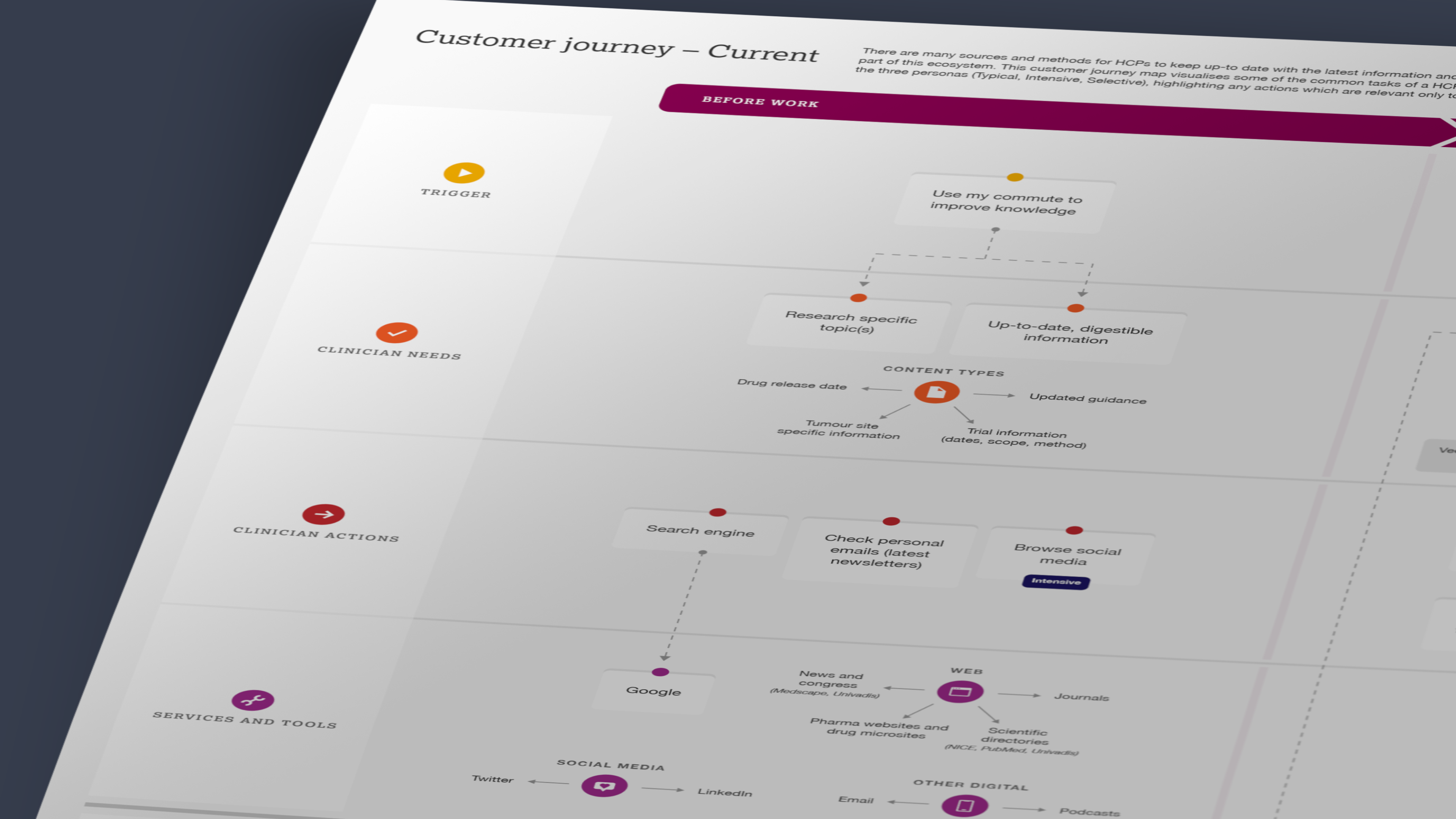
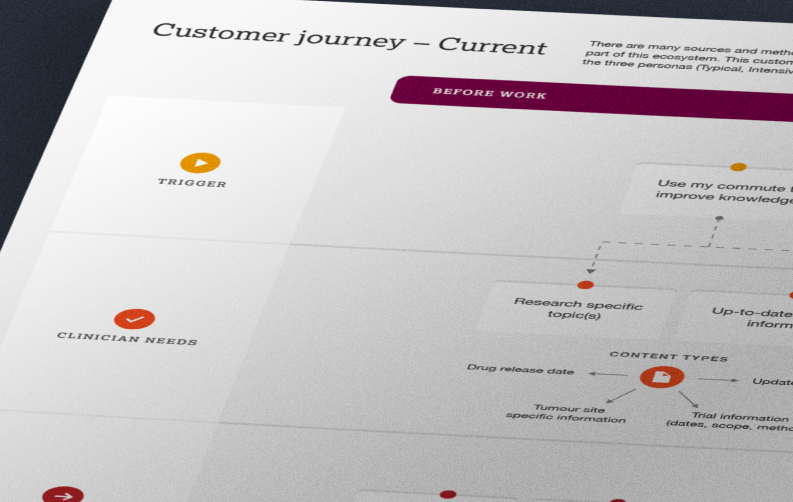
Using the research, we mapped the end-to-end clinician journey and developed a detailed service blueprint.
This enabled us to visualise how clinicians interacted with the organisation, where friction existed and which investments were creating little or no measurable value.
The blueprint revealed several opportunities to simplify the experience, improve relevance and redirect investment towards higher-impact activities.
The Outcome
The work provided a clear, evidence-based view of how clinicians engaged with information, education and support services.
We identified and prioritised opportunities using an impact-versus-effort framework, allowing stakeholders to focus investment where it would create the greatest return.
Beyond strategy, we continued to support implementation, helping teams translate insight into practical changes across programmes, channels and services.
The result was a more informed engagement strategy, stronger alignment across stakeholders and a clearer understanding of where investment could drive meaningful value.