Yesterday, I flew home from Málaga with Ryanair.
I was travelling with an oversized item: a child’s car seat. That put me outside the airline’s standard check-in process, although hardly into an unpredictable edge case. Ryanair carries millions of families. Car seats, pushchairs and oversized baggage are part of the everyday reality of running an airline.
Yet the process felt as though it had been designed without any real thought.
Checking in required a phone. The airport used dynamic QR codes. To deal with the car seat, I first had to find and flag down an assistant. The assistant then produced another QR code - not from a piece of airport equipment or an official check-in system, but apparently from WhatsApp on their phone - which I had to scan with mine.
Consider how many things had to work for that interaction to succeed.
My phone had to be charged, connected and in my hand. The right assistant had to be visible and available. I had to understand that there was a separate process for the car seat, despite there being little obvious guidance. Their phone had to be working. The QR code had to load. My camera had to recognise it. And we both had to complete this improvised digital handshake while surrounded by luggage, children, queues and the low-level anxiety that accompanies almost every airport departure.
This may have reduced the amount of equipment or staffing Ryanair needed to provide. It did not feel efficient to me.
More importantly, it did not look particularly efficient for the airport staff either.
The process had not eliminated work. It had redistributed it.
Some had been transferred to the passenger. Some remained with the assistant, who now had to be found and interrupted. Some had been turned into uncertainty, delay and repeated attempts. What appeared efficient from the centre became fragmented and fragile at the point of use.
That is the curious thing about badly designed self-service. It asks the customer to become the employee, troubleshooter and quality-control department - then treats the customer as the problem when the process fails.
Self-service becomes self-defence.
Customers do not always have a meaningful choice
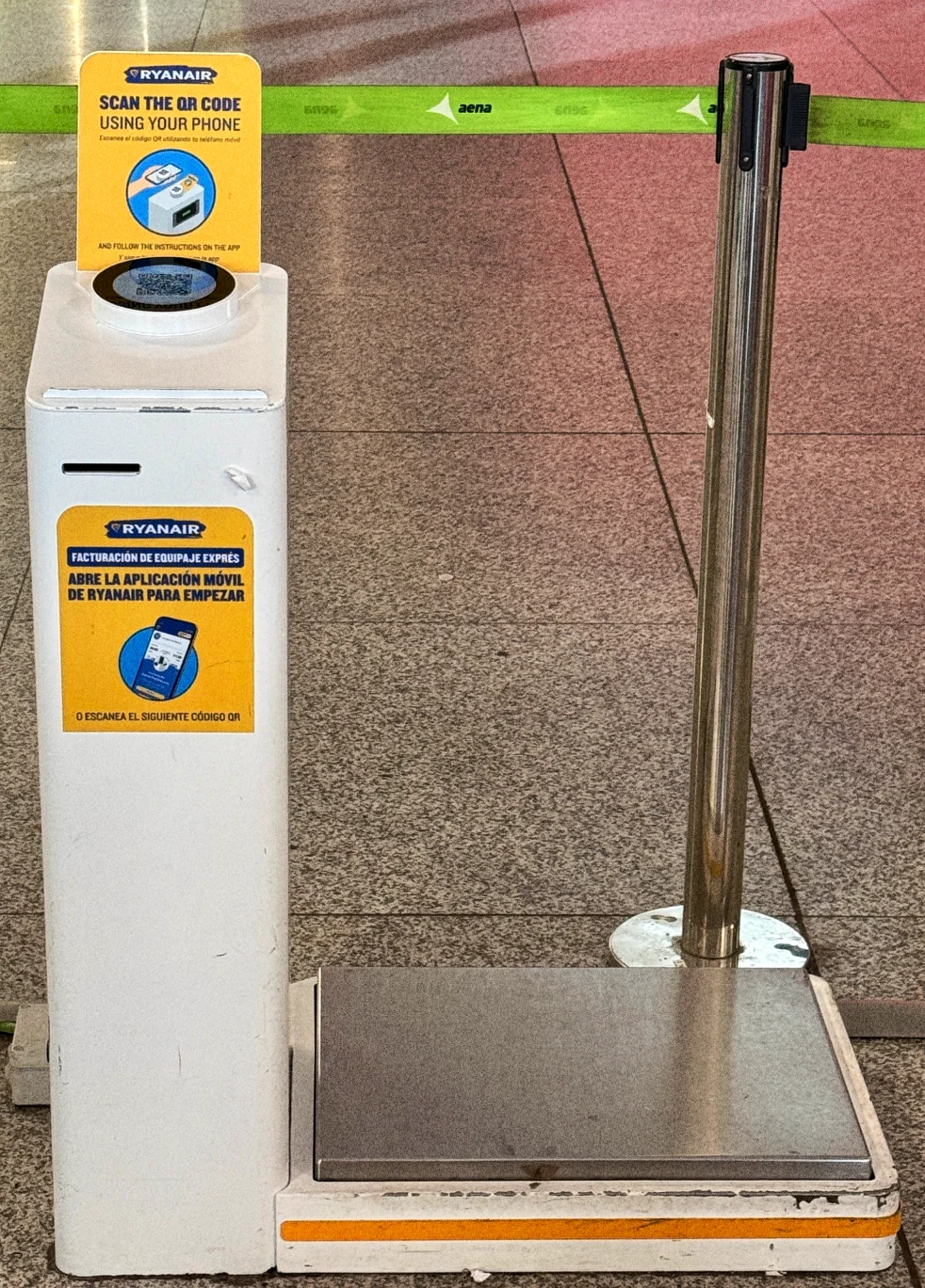
It would be easy to dismiss this as a complaint about a budget airline.
Ryanair is inexpensive. Its business model is built around operational efficiency. Everyone knows it is not selling luxury.
But that misses the point.
I was not looking for champagne, a red carpet or somebody to carry my bags. I wanted a clear, reliable process for checking in an item that families take onto flights every day.
Nor was I standing in an ordinary competitive marketplace at that moment.
Several airlines might fly between Spain and the UK. But once I had booked a particular journey, arrived at Málaga Airport and needed to get home at a particular time, the theoretical existence of another airline was largely irrelevant. Ryanair had what we might call a situational monopoly. It controlled the service I needed at the moment I needed it.
Walking away was not a meaningful option.
This is what makes some transactions different from ordinary purchases. Sometimes we choose a product because we want it. Sometimes we enter a service because circumstances compel us to complete it.
We have to catch the flight. Submit the mortgage application. Make an insurance claim. Restore access to a frozen bank account. Prove our identity. Attend the hospital appointment. Fix the broadband connection. Resolve the fraudulent payment. Complete the visa process. Cancel the contract.
These are distressed purchases or, more broadly, high-stakes service moments.
The customer may have chosen the provider months or years earlier. They may theoretically be able to choose another one in the future. But inside the moment itself, they have little agency. They need the process to work, and the cost of failure belongs overwhelmingly to them.
That imbalance matters because it can disguise poor service remarkably well.
Customers still complete the journey. The transaction still converts. The flight remains full. The test gets booked. The form is eventually submitted.
From the organisation’s point of view, the process appears successful.
But completion is not the same as satisfaction.
When customers cannot walk away, completion may not even be evidence that the service worked. It may simply reveal how much difficulty they were willing - or forced - to endure.
We saw the other side of this with ExpressTest
Our work with ExpressTest took place in a very different context, but it involved the same underlying service-design problem.
During the pandemic, international travel was governed by testing requirements that changed frequently and differed between countries. For many journeys, passengers were required to obtain a valid negative Covid test within a specified window. UK government guidance directed travellers who needed tests towards private providers that met the relevant minimum standards. Testing was not an optional enhancement to the journey. It could determine whether the journey happened at all. [1]
Our client became one of three solution providers operating in that space.
At first glance, the proposition appeared simple: book a test, take the test and receive a result.
But nobody was really buying a medical procedure.
They were buying certainty that they could travel.
Even that does not capture the whole emotional context, however. The test did not merely present an administrative risk. It presented a health risk.
Customers were worried that their certificate might not arrive in time. They were worried that they had booked the wrong type of test. They were worried that they had misunderstood the entry requirements. They were worried about losing the money they had spent on flights, accommodation or family events.
And, beneath all of this, they were worried that they might actually have Covid.
A positive result did not simply mean a failed transaction. It could mean illness, isolation and possible transmission to someone they loved. It might mean being unable to attend a wedding, see a relative, return home or take a long-delayed holiday. During the most uncertain periods of the pandemic, it could provoke genuine fear about what would happen next.
Research confirms that this was not a marginal emotional response. A 2021 systematic review and meta-analysis found high levels of Covid-related fear and anxiety across different populations, while a later review connected fear of Covid with anxiety, depression, stress, sleep problems and poorer mental wellbeing. [2, 3]
This was therefore a service with two possible sources of distress:
- Will the process allow me to travel?
- What will the result tell me about my health?
The customer needed logistical certainty while approaching an outcome that was inherently uncertain.
That distinction shaped the challenge.
We could not promise everyone the result they wanted. No honest service could. But we could design the experience so that people understood what would happen, what was required from them, where they were in the process and when they would hear from us.
We could absorb as much procedural uncertainty as possible, because the customer was already carrying enough emotional uncertainty of their own.
That, to me, is one of the most useful definitions of good service design:
Good service design absorbs complexity on behalf of the customer. Bad service design exposes the customer to the organisation’s complexity and asks them to manage it.
The problem is not self-service
I am not against self-service.
Good self-service can be faster, calmer and more convenient than waiting for an employee. I would rather check in online than queue at a desk. I would rather track a delivery than phone a call centre. I would rather make a simple change myself than explain it to three different people.
The academic literature has recognised these benefits for decades. Self-service technologies can give customers more control, improve access and reduce waiting. But research also shows that satisfaction depends heavily on whether the technology actually solves the customer’s problem. One of the foundational studies in this field, published by Matthew Meuter, found that both the success of the technology and the customer’s ability to recover from a failure are central to the experience. [4]
That is the crucial distinction.
Self-service is valuable when it gives the customer agency.
It becomes destructive when it merely transfers labour, risk and accountability to them.
Researchers have described this transferred effort as “consumptive labour” or “shadow work”: unpaid work once performed by employees that is now performed by customers. [5]
There is nothing automatically wrong with that exchange. I am happy to scan my own boarding pass if doing so saves time. I am happy to assemble a simple piece of furniture if that lowers its cost. I am happy to manage my account online if I gain speed and control in return.
The problem begins when the value flows in only one direction.
The organisation saves money, while I inherit another password, device dependency, unexplained error message or recovery process. The service has been optimised for the organisation’s cost-to-serve, but my own cost-to-be-served has been ignored.
That cost is not limited to minutes.
It includes attention, cognitive load, uncertainty and emotional effort. In a high-stakes situation, it also includes the risk of missing a flight, losing money, delaying medical treatment or being locked out of something essential.
The happy path is not the service
Many digital experiences are designed around a “happy path”: the cleanest sequence through which an ideal user completes a task.
The passenger has the right document. The customer remembers their password. The applicant’s address history fits the form. The patient speaks the expected language. The traveller has a charged smartphone and reliable data. The luggage is a standard size. The test result is negative.
Designing the happy path is useful, but it is not enough.
The real quality of a service is revealed when something deviates from it.
What happens when the passenger has a car seat?
What happens when the customer cannot receive the verification code?
What happens when the person has no smartphone, poor eyesight or limited dexterity?
What happens when a result is inconclusive?
What happens when the rules change between booking and travel?
What happens when somebody is frightened?
Exceptions are often discussed as if they were rare defects around the edge of the service. At sufficient scale, they are the service.
A process used by millions of people will encounter dead batteries, forgotten passwords, accessibility needs, delayed messages, unusual names, disputed payments, distressed customers and luggage of every conceivable shape. None of these is surprising. The precise individual may be unpredictable. The existence of the exception is not.
If the official journey cannot handle these circumstances, employees create unofficial ones. They use personal messages, handwritten notes, unofficial spreadsheets, screenshots and workarounds. That ingenuity may rescue the customer, but it also tells us something important: the service is relying on frontline improvisation to repair a design failure.
This creates what systems thinker John Seddon calls failure demand: additional demand caused by an organisation failing to do something, or failing to do it correctly, the first time.
The customer asks for help because the instructions were unclear. They call because the app did not explain the error. They approach a member of staff because the kiosk cannot handle the exception. Each contact appears as new work, but it is actually work generated by the original service.
This is why badly designed self-service can create the illusion of efficiency. A task disappears from one departmental spreadsheet only to reappear somewhere less visible: in longer queues, repeated contacts, staff interruptions, customer anxiety and abandoned trust.
Why conventional measures miss the damage
The most dangerous feature of a distressed purchase is that many familiar business metrics become unreliable.
A customer who successfully boards the flight counts as a completed transaction, even if they found the process bewildering.
A traveller who receives a Covid certificate counts as a fulfilled order, even if they spent the previous 24 hours uncertain whether the result would arrive.
A person who eventually recovers their bank account counts as a resolved case, even if it required four calls and caused days of anxiety.
The organisation sees the outcome. The customer remembers the ordeal.
Research into customer effort provides a useful corrective. Matthew Dixon, Karen Freeman and Nicholas Toman argued that reducing the work customers must do to solve a problem is a stronger route to loyalty than trying to manufacture elaborate “wow” moments. Their research found that difficult service interactions were especially likely to drive disloyalty. [6]
I think this is particularly important in high-stakes services.
“Delight” can sound frivolous when somebody is waiting for a medical result or trying to get home. The customer does not need theatre. They need clarity, competence and reassurance.
In these moments, delight is often simply the absence of avoidable distress.
It is seeing immediately which test you need.
It is knowing that your booking has been received.
It is understanding when the result will arrive.
It is being told what happens if something goes wrong.
It is finding a human being before you have exhausted every automated route.
It is a fallback that feels like part of the service rather than an admission that the service has failed.
Design for the emotional job, not only the functional task
A service journey normally contains at least two layers.
The first is functional:
What is the customer trying to accomplish?
The second is emotional:
What are they trying to feel, or stop feeling, while accomplishing it?
At ExpressTest, the functional job was obtaining a valid test result. The emotional job was achieving enough certainty to continue with an important journey while confronting the possibility of illness.
At Málaga, the functional job was checking in a car seat. The emotional job was knowing that my family and our belongings were correctly processed and that we would be allowed to board the flight.
A purely operational design sees the transaction.
A genuinely customer-centred design sees what the transaction means.
This is not a plea to make every interface sentimental. It is an argument for recognising that anxiety changes how people process information. Under pressure, customers have less patience for ambiguity and less cognitive capacity to decode unfamiliar instructions. Every unexplained step becomes evidence that something may be going wrong.
The service should therefore communicate more clearly, not less, at moments of high uncertainty.
This also connects with the peak-end rule, associated with the work of Daniel Kahneman and others. Research suggests that people’s memories of an experience are influenced disproportionately by its most emotionally intense moment and by how it ends. The principle has since been explored specifically in service settings. [7]
For ExpressTest customers, opening the result was the emotional peak. The arrival of a valid certificate was the end of the service and the beginning of their journey. Those moments deserved disproportionate design attention.
For an airline passenger, an unresolved problem at check-in may also become both the emotional peak and the final meaningful interaction with the airline before security. A fragile process at that point can colour the memory of the entire experience.
Five questions every organisation should ask
This issue extends far beyond airports and pandemic testing.
Every organisation has moments in which the customer’s freedom, time or emotional bandwidth is constrained. Those moments deserve more scrutiny precisely because customers are less able to leave.
I would start with five questions.
1. Where can our customers not realistically walk away?
Look beyond legal monopolies. Find the situational ones.
These may occur when a customer is locked into a contract, facing a deadline, dealing with an emergency or has already invested significant time and money. The question is not whether another provider exists. It is whether switching is a credible option in that particular moment.
2. What are customers really carrying?
Map the emotional stakes as well as the transactional steps.
Are customers confused, embarrassed, bereaved, frightened, angry or short of time? What happens if they make a mistake? What does the outcome mean beyond the immediate transaction?
The same five-minute delay feels very different when ordering a T-shirt and when waiting to learn whether you can travel, or whether you have Covid.
3. Where have we transferred work without transferring value?
List everything customers now do that an employee or system once did.
Some of that work may be entirely reasonable. But what do customers receive in exchange: greater speed, control, convenience or lower cost? Where are they simply subsidising an internal efficiency programme with their own time and attention?
4. What happens outside the happy path?
Do not ask only whether the main journey works.
Test expired batteries, poor connectivity, accessibility needs, missing documents, unusual luggage, changed plans, inconclusive results and frightened people. Observe what frontline employees actually do, including the unofficial workarounds absent from the service blueprint.
Those workarounds often contain the clearest evidence of what the formal service has failed to provide.
5. Are we measuring completion or confidence?
Completion tells us whether the customer reached the end.
Confidence tells us whether they knew what was happening, understood what was required and trusted the organisation to handle a problem.
Both matter. Only one of them is normally visible on an operational dashboard.
Useful measures might include repeated attempts, requests for clarification, avoidable contacts, time spent recovering from errors, intervention by frontline staff and the customer’s confidence at critical points, not just their eventual completion of the transaction.
Efficiency and care are not opposites
There is a tendency to frame this debate as a choice between commercial efficiency and customer care.
That is too simplistic.
A well-designed service can reduce both operational cost and customer effort. Clearer instructions can prevent calls. Better status updates can reduce uncertainty and repeated contact. Thoughtful exception handling can stop staff being interrupted. Accessible digital journeys can allow more customers to complete tasks independently.
The goal is not to add a person to every interaction.
It is to put human support where human judgement or reassurance is valuable, and ensure that digital systems do not generate the very demand they were introduced to remove.
ExpressTest operated under extraordinary pressure: shifting regulation, significant volume, medical responsibility and customers with immovable travel deadlines. The answer was not to pretend that those constraints did not exist. It was to prevent as much of that complexity as possible from landing on the customer.
That lesson applies anywhere a transaction carries consequences beyond the transaction itself.
Customers may forget a slick animation or a clever piece of copy. They will remember whether the organisation made a frightening moment calmer. They will remember whether the process gave them confidence or made them feel foolish. They will remember whether someone took responsibility when the system stopped working.
And they will remember being treated as a human being rather than as unpaid infrastructure.
Self-service should extend our agency. It should make ordinary things easier and give us more control over our time.
When it instead forces us to locate the right employee, obtain an unofficial QR code, diagnose the organisation’s process and protect ourselves against its failure, it has crossed a line.
It is no longer self-service.
It is self-defence.
References
- UK Government, Private providers of coronavirus testing.
- Luo et al., Systematic Review and Meta-Analysis of Fear of COVID-19.
- Şimşir et al., Fear of COVID-19 and its association with mental health-related factors.
- Meuter et al., Self-Service Technologies: Understanding Customer Satisfaction with Technology-Based Service Encounters.
- Koeber, Wright and Dingler, Self-Service in the Labor Process.
- Dixon, Freeman and Toman, Stop Trying to Delight Your Customers.
- Oxford Academic, The peak-end rule.